
You Mad Bro?
Adam Suffoletto
Professor Ristow
Writing & Rhetoric 333
17 February 2026
Have you ever had a friend who always says the right thing at the right time, simply to get you going? The kind of guy whose face lights up whenever he sees your angry reaction? I can personally attest to the thousands of times my friends have made fun of the way I walk, my large nose, and a plethora of other things. Most of their laughter after the fact isn’t about the joke itself; it’s about how I respond. That’s where the internet saw an opportunity to summarize it in one word. The term “ragebait” was born and is now a rhetorical device that leverages emotional provocation to manufacture engagement within the economy.
A term like this is really hard to define. I’ve always felt that words that come from internet trends do not really have a definition. It was always a “if you know, you know” situation in my eyes. Hence, I consulted the Merriam-Webster Dictionary to define the word. It said ragebait “is content (usually, but not always, found online) that tries to provoke anger or outrage, as a means of gaining attention or making money.” This essentially boils down to using the most powerful emotion, anger, to manipulate people into interacting with a post. A good example of online ragebaiting would be when Max Kellerman went on ESPN and said that he would rather have Andre Igoudala take a game-winning three-point shot over Stephen Curry, who is the NBA’s all-time leading three-point shooter. Another good example would be when President Trump posted an AI-generated video of himself flying a military jet dumping waste on protesters beneath him. This type of engagement isn’t based on curiosity or interest; it’s based on pissing people off and getting them to like or comment, which will gain the creator more views. I look at it from more of an everyday life perspective. While it’s a strategy, I use it pretty much every day when talking to my friends. Just last night, my roommates “ragebaited” me into screaming at them for asking dumb questions during Star Wars. I mean, who puts on Revenge of the Sith and proceeds to ask, “Wait, is Darth Vader really Anakin Skywalker?” It was very frustrating. So while some would consider that antagonizing.
As I was describing what this term represents, you might have wondered how it differs from the words antagonize and instigate, which seem to be synonyms in the eyes of many. Insitagate is definitely the lesser of the two, as instigating is more about getting a general reaction out of someone, where ragebait is exclusively about making people angry. Antagonizing is definitely more about making people angry, but the intent behind the action is what separates the two. Ragebaiting is a public relations strategy designed to make people angry to drive engagement, while antagonizing is mostly out of personal disdain. The key distinction is that what is posted online that is interpreted as ragebait is intentional. It is meant to sell something or get people talking about something. That is extremely important in understanding why this word works the way it does.
A few aspects of The Medium is the Massage by Marshall McLuhan were relatable to the increasing number of words and phrases coming from the internet. Social media generally produces a lot of emotion from users. This is simply because those on social media are exposed to a lot of things they probably would not otherwise see. Whether it’s a capybara peacefully swimming in a lake or some absolutely heinous, disgusting accident, the internet has it all. Seeing some of this stuff can be unsettling and set off a wave of uneasy emotion. The same applies to anger. When President Trump went on the air and said he would be cutting many of the diversity, equity, and inclusion initiatives from the federal government, it sparked instant outrage from people online. It was a similar situation early on in Trump’s political career with his debate clips, where he was attacking other candidates. There was a LOT of negative talk about him and his methods. But when analyzing his public relations strategy, Trump just wants as many eyes and ears on him as possible at all times. What better way to do that than anger? McLuhan writes, “The ear favors no particular ‘point of view.’ We are enveloped by sound. It forms a seamless web around us.” When people hear certain things, they react a certain way. If they see a post that’s not interesting, they scroll. If they see a post they like, then they’ll press the like button. But if they see a post that angers them, many will comment and share. That type of engagement is great for creators, and McLuhan places an emphasis on the effect media can have on these types of reactions.
It’s also interesting to see when and why words such as these come to prominence. The blue line on the graph below (figure 1) represents the word ragebait, and the red line represents a similar word, clickbait. Clickbait is essentially exaggerating something to get people to click on it, which makes it fairly similar to ragebaiting. A good example of clickbaiting is when you get a notification on your phone that says something along the lines of “You’ll never believe what Pam Bondi just said.” Despite the similarities between the two words, their usage surprisingly has very little correlation over the past three years.
Clickbait actually peaked back in 2021 and has since settled into pretty consistent usage. That’s fascinating, as this word was quite literally a dumb social media trend that turned into a marketing strategy used pretty commonly in today’s world. On the other hand, ragebait is currently at its peak usage. It will be interesting to see if it will also transition into becoming a regularly used expression or if it will remain a trend.
Ragebait sits at the intersection of rhetoric, media economics, and human psychology. What starts as a joke or a jab quickly becomes an engagement strategy built on emotion. The line between humor and manipulation is thin, and audiences become both consumers and fuel. Unlike antagonizing or instigating, ragebait is structured, packaged, and monetized. It thrives because the reaction is money. Understanding it is less about defining a word and more about recognizing a system that rewards outrage over substance. In that sense, ragebait is not an anomaly of the internet, but rather is a reflection of it.
Works Cited
McLuhan, Marshall, and Quentin Fiore. The Medium Is the Massage: An Inventory of Effects. Random House, 1967.
“Ragebait vs. Clickbait.” Google Trends, Google, https://trends.google.com/explore?q=ragebait%2Cclickbait&date=2023-02-16%202026-02-16&geo=US. Accessed 17 Feb. 2026.
“Rage Bait.” Merriam-Webster.com Dictionary, Merriam-Webster,
https://www.merriam-webster.com/slang/rage-bait. Accessed 17 Feb. 2026.
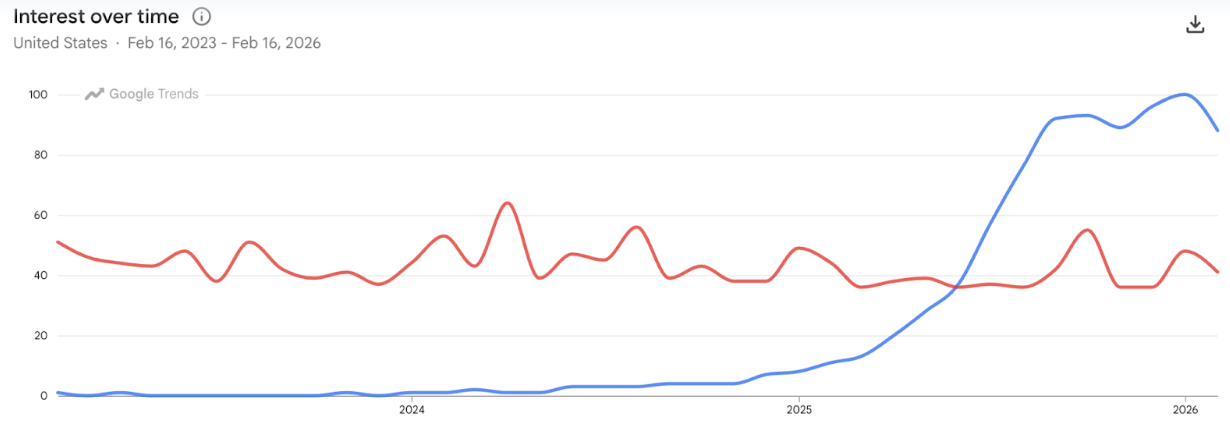
Figure 1